Monday, April 30, 2012
2012 Lifetime Achievement Award Native Writers’ Circle of the Americas
Monday, April 23, 2012
Red Riot: Emerging Native American Voices and Poetics by Natanya Ann Pulley
![]() |
| Bunky Echo Hawk 'Colonizer Bunny' |
Natanya Ann Pulley guest blogs on 'Girls in a Tight Place.' Read all about it HERE
Excerpt: I began to write non-fiction without the pressure to speak to/for a people held in, between or from tradition. I wrote for me: the me that threw my arms up and said, I don’t know how to do any of it! How to recover a heritage—how to speak to a past time—how to hold it all together. My mother left the Navajo reservation when she was five to live with an LDS family in the Indian Placement Program. There is too much in that one line for any one story, for one book, for one life. There is too much in it and I have learned to respect it. To respect that it is a still-beating thing. That my heritage shifts in color, size, texture. It sings many songs and continually cuts its own legs off to start again. It boils to steam and drifts to airs and comes back to me in rain, wind, in breath. In smog.
Friday, April 13, 2012
Trilling!
Today I was thrilled (trill-worthy!) to see Dine author and fellow co-editor Natanya Ann Pulley's "An Open Letter to Johnny Depp's Tonto" published in McSweeney's Internet Tendency. This is major coup (yes, a pun!) for Native writers; we don't often see our names published in mainstream publications and most certainly not in this context--a letter of protest, but a really scathingly funny, clever and dare I say, non-confrontational, letter of protest.
For any of you just tuning in Natanya and I have been compiling submissions for "Good Medicine: A Native Anthology of Humor" to be published by Lost Horse Press. This is a photo of me posing next to my inner bitch, and this is a photo of Baby Natanya posing with a glob of green
slime, or maybe her lunch? Who am I to question the traditional Navajo cuisine.
Monday, April 02, 2012
Big Poetry Giveaway
When I first heard Giveaway I thought, "It's too early for the Oil Celebration!" Giveaways --also called potlatch by the Northwest Coast tribes -- are big happenings in Indian country.
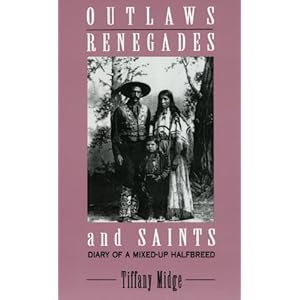
But for this giveaway I'm taking part in the Book of Kells 2012 Big Poetry Giveaway created by poet Kelli Russell Agodon for National Poetry Month. I'll be giving away a copy of my book "Outlaws, Renegades and Saints," published by Greenfield Review Press and a copy of the groundbreaking anthology "Without Reservation; Indigenous Erotica," edited and published by Kateri Akiwenzie-Damm of Kegedonce Press.
Want to win? Just leave a comment on this post now through April 30 and I'll draw winners out of my medicine basket for each book during the week of May 1. To see the full list of poet bloggers taking part in the giveaway, visit Kelli's blog, Book of Kells.
About the books:
At the Oil Celebration Powwow
i.
At the oil celebration powwow give-
aways are the gift that keeps on giving.
The Indians true to their traditions continue
to give what the whites have taken from them—
ii.
food when they were starving
blankets when they were freezing
clothing when they were naked
iii.
Ethel Iron Thunder gives a Pendleton wrap to Minnie Spotted Elk/
Minnie Spotted Elk gives a star quilt to Silas Tail Spins/
Silas Tail Spins gives 20 lbs of frozen venison to Victoria Walking Child/
Victoria Walking Child gives a case of chokecherry preserves to John & Myra Two Feathers/
John & Myra Two Feathers gives Cain Long Bow $100 towards his college tuition/
Cain Long Bow gives Alice Brought Plenty 10 yards of bargain basement fabric/
Alice Brought Plenty gives Ruby Savior a plastic bag of accumulated Copenhagen chew-top-lids/
Ruby Savior gives Mary & Victor Red Wing a beaded cradleboard for their new arrival /
Mary & Victor Red Wing gives Scarlet Comes At Night their family’s secret frybread recipe/
Scarlet Comes At Night gives Ethel Iron Thunder insulated rabbit fur slippers and matching
blue mittens and scarf.
iv.
Define Indian giver in 10 words or less:
All of the above.
v.
Grandma Iron Thunder tells me
that Giveaways are to Indians
what Christmas is to white people.
~Tiffany Midge "Outlaws, Renegades and Saints"
Without Reservation
Edited By Kateri Akiwenzie-Damm Co-Published with Huia Publishers, New Zealand.
Poetry by Joy Harjo, Sherman Alexie, Jack Forbes, and Richard Van Camp among many others.
The writing in the anthology is overwhelmingly contemporary, although some stories and poems are based on old tales. Ipellie,an Inuit writer based in Ottawa, is one such spinner of tales, including Summit with Sedna, the Mother of Sea Beasts, a story about the coupling of an Inuit shaman and the mythological underwater creature called Sedna. Other stories are thoroughly modern, including 'Year of the Dog', a hilarious and ribald tale about some porno addicts in the contemporary Northwest Territories.
We Can See It With Our Eyes Closed ~ by Joy Harjo
You ask me what I am thinking when we make love
and our eyes are closed and the sun is climbing halfway
to the roof and the neighborhood dogs are all in love
with the spirit dog who makes the rounds and tortures them
with dreams of hills and running with the smell of heat
and then the train adds to the song of progress
making a web from city to city,
backdoor to backdoor and I know it is possible to
fly without complications of metal and engineering
and all the payoffs, paybacks and terrible holes
in the earth and here we are in the territory of the wind,
surrounded by devils and thieves, forgotten by a trickster god
who has a wicked sense of humor
yet there is something quite compelling
about this skin we're in, a solid planet of gases and water
doesn't tell the whole story. I am intrigued by cloud
language and see you approaching as a red flower in a meadow
of yellow, or you are an apparition of rain just before or after
a famine of butterflies. We make an electrical reaction
like carbon dioxide, and did I remember to blow out
the candles lit for those who are dying and are leaving
or will leave this place? Grief is a land of wet tenderness. We are all
dying and will leave a trail like the plane jetting east in the direction
that becomes all directions, become all the millions of souls here together
looking for god or a little something to eat,
all of us blown away by the mystery of nothingness
as we shop in the streets for trinkets or bread.
We've been here before, thinking in skin and our pleasure
and pain feeds the plants, makes clouds. I see it with my eyes
closed. It's so beautiful. There's the telephone.
The UGH: Uncivilized Grunting Heathen drawing is open from now through ALL OF APRIL, National Poetry Month!
If you'd like to be entered, please leave your name and email address by midnight, APRIL 30th, 2012 in the comment section of this post and I'll be drawing 2 lucky winners for the books during the week of May 1st, 2012.
Good luck & Good Read
Wednesday, September 07, 2011
Gerald Vizenor is 2011 American Book Award Recipient
University of New Mexico Distinguished Professor of American Studies Gerald Vizenor is the recipient of the 2011 American Book Award for Shrouds of White Earth. The award is presented by the Before Columbus Foundation. The book is about contemporary Native American Indian artist Dogroy Beaulieu, who reveals his story to a native writer.
Dogroy is a painter by nature, an intuitive visionary artist. He creates shrouds of sacrificed and crucified animals and birds, the faint traces of natural motion on linen, at his studio on the White Earth Nation in Minnesota. The very sight of the shrouds torments the traditional fascists on the reservation, and the faint traces of native totems haunt the patrons of galleries and curators of museums. “I create traces of totemic creatures, paint visionary characters in magical flight, native scenes in the bright colors of survivance,” Dogroy declares.
His artistic sentiments and shamanic tribute to the shrouds, however, do not protect him from envious enemies on the reservation. Dogroy is banished by casino politicians, in flagrant violation of the new Constitution of the White Earth Nation for his artistic tease, his baroque mockery and his ironic portrayals.
This unforgettable journey of discovery and creativity ranks as one of the finest stories from the pen of the irresistibly witty and insightful Gerald Vizenor.
“The inventor of invention rides again. In this book, the master trickster takes on the disciplines of visual art, narrative, and song in his ongoing campaign against victimry, to set natives upright and to insure the truth of native survival. Gerald Vizenor is the healer of irony with his focus on the native paradigm. What a pleasure to ride into Vizenorland, where colors spread and horses fly. Vizenor is my chosen composer of words.” — Diane Glancy, author The Reason for Crows
Vizenor’s many books include Interior Landscapes, Second Edition: Autobiographical Myths and Metaphors, also published by SUNY Press; Fugitive Poses: Native American Indian Scenes of Absence and Presence; Manifest Manners: Narratives on Postindian Survivance; Hiroshima Bugi: Atomu 57; and Survivance: Narratives of Native Presence.
Tuesday, August 23, 2011
Fresh!
Out of University of Arizona Press and soon to be available in October is SING; Poetry from the Indigenous Americas.
SING might seem familiar to devotees of Ndn poetry and that's because a third of it was in a journal called To Topos: Poetry International Published in 2006 by Oregon State University.
From the University of Arizona Press website:
Editor and poet Allison Hedge Coke assembles this multilingual collection of Indigenous American poetry, joining voices old and new in songs of witness and reclamation. Unprecedented in scope, Sing gathers more than eighty poets from across the Americas, covering territory that stretches from Alaska to Chile, and features familiar names like Sherwin Bitsui, Louise Erdrich, Joy Harjo, Lee Maracle, and Simon Ortiz alongside international poets—both emerging and acclaimed—from regions underrepresented in anthologies.
|
A reading from SING at The University of Arizona Poetry Center, November 7th, 2011, 7pm will feature editor Allison Hedgecoke, Sherwin Bitsui, Travis Hedge Coke, Natalie Diaz, Mariah Gover, Simon Ortiz, Layli Long Soldier, Laura Tohe, Orlando White, Steven Yazzie, and Ofelia Zepeda.
http://poetry.arizona.edu/news-event/2011/11/reading-sing-poetry-indigenous-americas
Monday, August 22, 2011
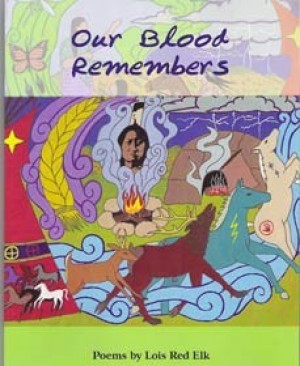
Our Blood Remembers by Lois Red Elk
If you Google Lois Red Elk you will be pleased to discover dozens and dozens of hits that feature her film roles. I’ve enjoyed many of Lois’ films over the years: Skins, Lakota Woman, Outside Ozona, just as much as I’ve enjoyed her published poetry over the years. This year Lois released her first collection of poetry Our Blood Remembers by Many Voices Press. Congratulations Lois!
The following is a review from The Herald News out of Roosevelt County, Montana.
By Lara Shefelbine
A Wolf Point woman who has written for more than 50 years has published a collection of poems in her first book, bringing alive numerous memories of her lifetime, childhood and family experiences on the Fort Peck Reservation.
In the book Our Blood Remembers, Lois Red Elk weaves together a series of anecdotes and thoughts from her lifetime using dazzling, imaginative poetry.
Red Elk, a member of the Sioux Nation and an enrolled member of the Fort Peck Tribes, tells of her childhood spent growing up between Poplar and Wolf Point and the lessons she learned being raised by her father, mother and influential grandmothers.
Not only does the author detail meaningful events of her lifetime, Red Elk also shares some of her favorite Dakota/Lakota words and phrases. Her perspective brings a new light to topics ranging from the importance and significance of family to the exploitation of Native American culture. The content of the poems contained in Our Blood Remembers ranges from the distant past and the old ways to the present and the changes that have occurred with the passage of time.
All in all, Red Elk offers an undisguised look at the Sioux culture that defines her life and encourages us to feel the emotions that run deep in the blood, which truly does remember.
Our Blood Remembers was published by Many Voices Press of Flathead Valley Community College. It is available at Fort Peck Community College, where Red Elk teaches Indian studies, and online at Amazon.com.
Grandmother Praying
by Lois Red Elk
...
Every morning it was a ritual; I would hear her stirring,
knew she was putting on her moccasins, bed creaking
told me she was collecting her hair into one long braid,
nimble fingers flexing then pulling a robe around her
motherly frame. Her breathing was steady but hurried,
sometimes a cough or a hum, to let us know she was
beginning her time with the new day. The door would
open quietly, fresh air would flush through the rooms,
then out the back windows leaving sweet smells of
dew on morning grass. These moments that have been
imprinted in my mind, I bring back weekly, make
them my own present knowledge, my faith. I see
where she is standing along side our old log house,
watch the morning breeze lift loose hairs around her
temples into fine ripples. Her dark eyes receive spirits
who dwell in sun’s rays, just above earth and warmly
mingle with quivering poplar leaves and songs of
meadowlark and robin. To the east, where all life
begins, she raises a hand to touch the Great Spirit’s
space, the place where connection is made with the
sacred world. In her other hand she carries a small
braided circle of sweet grass, mother earths generously
imparted, fragrant hair as her communion offering from
the mortal, to ancestors and angels. Grandmothers
whisper softly unifies with the essence of increasing
light, her greeting, her acknowledgment of the sacredness
has begun. Two slight steps and her body faces south.
She bows in reverence, humbly lowering her face as a
common human being portraying the difficulty to stand
upright before the moving power of the creator. A tear
slides to the soil, another sacrifice from her frail stature
as she asks forgiveness for the failures of her people and
her offspring. She knows the difficulty of maintaining
custom and practice, how insistent dark energies pry away
loved ones from wisdom and grace to error and ignorance.
And, she knows this direction of growth will win the battle,
that all will be forgiven and restored. Her body
straightens and is strengthen as she meets the west,
meets that dark strength approaching and forming
into healing clouds. It is where the infinite voice of
Thunderbirds lightning oath will bring renewal.
Grandmothers knows that source of replenishing rain
brings needed purification. She thanks all the powers
who will quench the thirst of all life. And she knows
she too will have the comfort of thunders blessing. She
has come full circle. The peace of the north welcomes
her and her prayers – that tireless course she claims as
wont. She will witness and celebrate abundant rewards
for a people reclaiming birthright then receiving the fruit
of supplication. That sacred journey through the morning,
the universe has been with the Great Spirit as direction,
her devotion in life. She knows this has always been the
true spirit of her people. This day, that collective spirit,
that humble utterance from a woman dedicated to her
ancestry, is brought before eternity, before the witness
of the all knowing, loving entity, beholding for all time.
Monday, May 23, 2011
Native Poets in D.C.
This is the link to the web cast for the auspicious reading of "The Florida Review, Native Issue" at the National Museum of the American Indian this last January. I couldn't go because I didn't have anything to wear, that being among my most preeminent concerns, vain as I am.
See, you assume I'm listening to these web casts, but I'm actually mentally cataloging people's outfits. I once panned a highly respected poet because I thought her blouse was really unflattering. And don't get me started on accessories! Just because access is in accessory doesn't mean you have an obligation to drape it on your body.
I was very pleased and delighted with the ensembles this fine group of poets happened to wear to the reading -- it can be hard to pull off in the middle of winter! It's nearly impossible to wear cute shoes in the winter let alone cute shoes that happen to match your outfit!
Black was a very dominant color for the program; I suspect the organizers gently suggested to the poets that black would be the most flattering for the camera, plus it's so slimming, how could you go wrong?
I bought a very cute velveteen black dress this winter, ordered from a catalog ( I had planned to wear it to a reading in Missoula, Montana) but when it arrived it had very little resemblance to the color black at all--it was more like a pewter or blueish gray color. I thought I could live with it, but there really is no substitute for black and I don't care what Tim Gunn might say about brown being the new black, there just is no substitute. Speaking of ordering from catalogs: a friend of mine ordered a velour hoodie from a catalog; she selected the color ZODIAC, thinking surely it was black. Except it wasn't. It was brown. Do you think zodiac is brown? Definitely not!
I'm super pleased to have this webcast, so many shiny outfits! They coordinate so well with the poetical part of the program. Enjoy! (P.S. You'll notice a handful of supermodels in this webcast, I don't know why Native poets are getting so much better looking than the previous wave, but they appear to be much taller and with better teeth; present company excluded, of course! ;-)
"Sure, that poem was a'right, but did you see her SHOES?!"
This is the link again.
Tuesday, January 11, 2011
Is 'Native Erotica' an oxymoron?
Ojibway author Drew Hayden Taylor addresses the puzzling myth that Natives are asexual beings. In his essay, "Indian Love Call," he writes: "In the vast majority of non-Native literature, Aboriginal characters, just as they never have a sense of humour, are rarely ever viewed as sexual beings. And if they are, their sexuality is not healthy. Kidnapping, rape and other assorted defilements are the order of the day on this particular pop culture menu. Tender love stories involving Native people are scarcer than priests at a residential school reunion."
In order to remedy this Taylor edited the anthology "Me Sexy
Taylor writes: "If you’ve ever wondered about the relative abundance of pubic hair among women and men of the First Nations, you don’t have to feel alone anymore." Those are comforting words.
In 2003, Kateri Akiwenzie-Damm's press Kegedonce published "Without Reservations: Indigenous Erotica." Following this collection, Kegedonce has published several other amazing First Nations' poets running along this same theme of love and erotica. Poets such as Al Hunter's "The Recklessness of Love." And Joanne Arnott's "Steepy Mountain: Love Poetry.
University of Arizona's literary magazine "Red Ink," came out with an erotica edition in 2002 (Cover art above).
"Indigenous Erotica is political. More than that, it's stimulating, inspiring, beautiful, and sometimes explicit. It's written by indigenous writers, painted by Indigenous painters, filmed by Indigenous filmmakers, photographed by Indigenous photographers, sung by Indigenous singers." -- Kateri Akiwenzie-Damm
Perhaps encouraged or inspired by these collections and anthologies I put out the chapbook "Guiding the Stars to Their Campfire, Driving the Salmon to Their Beds."
But what is poetry if not love poetry; all poetry is love poetry isn't it?
sweetheart when we make love press brown skins & lovely bones together and are 2 halfbreed hearts grooving to the same fullblood dance we create not only a whole indian song (your chippewa chants to my lakota tune) but sweetheart in the dark we become the entire tribe -- Tiffany Midge
The poet Deborah Miranda wrote a compelling paper called "Dildos, Hummingbirds, and Driving Her Crazy: Searching for American Indian Women's Love Poetry and Erotics," which was inspired from the absence of Native poets in a course she enrolled in at the University of Washington called "Women's Love Poetry and Erotics." Much of Miranda's own poetry runs the gamut of love and erotica; her collections "The Zen of La Llorona," and "Indian Cartography," contain exquisite thresholds and pronouncements, celebrations and laments in the ways of love.
Love Poem to a Butch Woman
by Deborah A. Miranda
Mohawk poet Janet Rogers has just released a collection of spoken word called "Red Erotic." The book also features photographs of erotic works by eight Indigenous artists. Rogers has been up to a lot, blurring the line between performance, spoken word and written expression. She was featured in this interview at Black Coffee Poet.
I'm sure I've left out of excellent stuff and when I hear of new things I'll add them to my growing list.
Saturday, January 08, 2011
Fresh! Florida Review; Native Issue
The new issue of Florida Review arrived at my doorstep when I got home from the holidays. Essays and poems and stories, Oh My! The issue is dedicated to Louis Owens and edited by Jocelyn Bartkevicius and Toni Jensen with cover art "Enchanted" by Marla Allison. The contents feature some of the usual suspects but also new emerging voices.
A special reading of the issue will be presented at the AWP at the National Museum of the American Indian in Washington D.C., and there will also be a panel of contributors for the conference, titled "A New Generation, a New Conversation."
I have two extra copies and if you write to me at Tiffanymidge@aol.com I will mail the first two lucky people who respond your very own copy! Free!
Here's the Table of Contents:
Fiction
- Gerald Vizenor - Captain Eighty
- Allison Adelle HedgeCoke - Ai-ye Ai-ye
- Travis HedgeCoke - Alien in Nature
- Layli Long Soldier - Mockery
- Stephen Graham Jones - Girls
- Erika T. Wurth - Like a Phoenix
- Natanya Ann Sturgill-Pulley - The Way of Wounds
- Thomas Peacock - Soft Wind
- Melissa Michal - Phillip
- Geary Hobson - Arrowhead
Nonfiction
- Stephen Graham Jones - Another Final Frontier
- Sara Marie Ortiz - Flight
- Sara Marie Ortiz - Penumbra and Thrum
- Tiffany Midge - Ten Ways to Consider the Great Spirit
- Tiffany Midge - Of Birds: Variations on a Theme
- Tiffany Midge - Indian Chat Room
Poetry
- Orlando White - Empty Set
- Orlando White - f
- Orlando White - h
- Santee Frazier - Mangled in the Demolition Derby
- Santee Frazier - Twice Ruined
- Santee Frazier - The Skewered Face
- Sherwin Bitsui - from Flood Song
- Thomas Hubbard - A Few Old Stories
- Tacey M. Atsitty - Calico Prints
- Tacey M. Atsitty - Mothway
- Tacey M. Atsitty - S. Influenza
- Ahimsa Timoteo Bodhrán - arco iris
- Ahimsa Timoteo Bodhrán - each stone
- Kimberly L. Becker - La Doncella
- Alice Azure - August Offerings
- Susan Deer Cloud - You Are Driving North in November
- Susan Deer Cloud - Globe
- Chip Livingston - Come to the Den of My Hills
- Chip Livingston - A Proposal
- Chip Livingston - Mixed Blood at Catholic School
- Denise K. Lajimodiere - Dakota January
- Denise K. Lajimodiere - The Bush Dance
- Denise K. Lajimodiere - Father
- Sy Hoahwah - Allotment
- C.R. Resetarits - Flint Hills
- C.R. Resetarits - Territories
- Marianne A. Broyles - Going Out to Sea
Interview
- Native Poetry: A Conversation Between Santee Frazier and Sherwin Bitsui
Wednesday, December 22, 2010
Review of Winter 2010 issue of The Kenyon Review
This is an old review but it bears repeating, DONCHATHINK? Is it "bears" repeating, or "bares" repeating? When I use the word "bear" the pain etc... I can't help but giggle -- English is SO silly, I swear! The cover art for this issue of Kenyon Review is by Luminary Extraordinaire Leslie Marmon Silko. I heard that at last year's Denver AWP someone swiped a whole big box of them. Isn't that whack?! But enough of my rambling, here's the review, written by some white guy with a funny name, who should be thanked. Someone give Nate a salmon, eh?
The Kenyon Review
Winter 2010
Quarterly
Review by Nate Whipple, Utah State University
This issue is dedicated to work by North American indigenous authors. With work from emerging voices like Sara Marie Ortiz, Eddie Chuculate, and Eric Gansworth as well as the acclaimed writers like Leslie Marmon Silko, LeAnne Howe, and Joy Harjo, the writing in this issue is as vibrant and dynamic as the indigenous literary tradition it represents. Compiled here is a stimulating survey of indigenous poetry, fiction, and nonfiction.
Indigenous life and culture awareness is greatest at the intersections of “land, culture, and community” (a phrase repeated five times over the course of the interview with Simon Ortiz that opens the collection). These intersections inform the work of each of the indigenous writers represented here and help unify their perspectives as each attempts to understand nature of individual identity in contemporary culture, indigenous or otherwise.
In the remarkable assortment of indigenous poetry collected here, a noteworthy gem is “A Blur of Echoes.” This deceptively simple poem by Marc Turcotte speaks with clarity and grace to the blurred boundaries that exist at the intersection of self, other, and community. The poem’s form (three blocks of text that read more like paragraphs than stanzas) indicates that identities aren’t the only things being blurred in indigenous literature and its opening provides what could be an instructive line for reading the entire collection: “Let’s forget everything we know to be true about you and me.” Turcotte’s evocative poetry is one of many works in the issue that illustrates the profound possibilities for understanding interconnectedness that unity among individuals and cultures can offer.
LeAnne Howe’s short story, “Due Diligence, or How I Lost Ten Pounds,” illustrates how interconnectedness can also mean misconceptions, miscommunications, and miscomprehensions. Told with a sardonic humor characteristic of much indigenous fiction, this clever story about a Choctaw author explores the complications of unity without understanding and the importance of language to individual and cultural identity.
Each of the thoughtful poems, stories, and essays in this issue demonstrates a profound respect for the reciprocal relationship between language and self and the role of literature in the formation of identity, individual or otherwise. But as Simon Ortiz, who serves as special guest editor for this special issue, points out in a moving interview with critic Janet McAdams, indigenous literature has been met with neglect. The cause of this neglect, says Ortiz, is a lack of critical attention, a “marginalization resulting from discrimination by mainstream academia and critics.” This is probably why this issue of The Kenyon Review contains perhaps more critical writing than any other. A critical essay by Angelica Lawson charts the role of language in the bi-lingual poetry of Ofelia Zepeda. Language, she notes, is essential to cultural resistance and resilience in the face of change, loss, and amalgamation.
Ortiz’s goal for this issue, he explains, was to contextualize indigenous literature in order to promote indigenous language, increase cultural awareness, promote and to give the literature and culture of indigenous people the attention they deserve. If there’s anything we need more of, it’s cultural awareness. If there’s one thing this issue of the The Kenyon Review demands, it’s more of our attention.
http://www.newpages.com/magazinestand/li